<!– SPDX-FileCopyrightText: 2026 Ahmed Imamovic SPDX-FileCopyrightText: 2026 Tarik Hamedovic SPDX-FileCopyrightText: 2026 Dan Gisselquist SPDX-License-Identifier: CC-BY-SA-4.0 –>
Tracking Algorithm
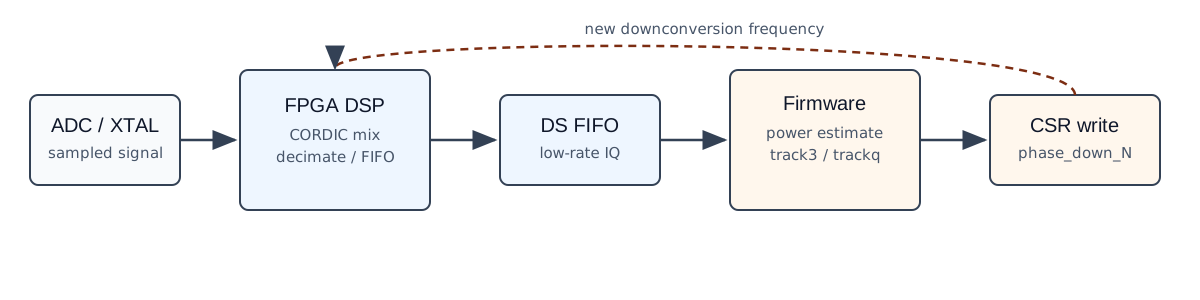
The tracker is a small software loop wrapped around the FPGA DSP path. The FPGA
does the expensive, timing-sensitive work: CORDIC mixing, filtering,
downsampling, and FIFO movement. The firmware only sees a low-rate stream. It
measures where the tones landed, then writes a new phase_down_<channel>
value through the LiteX CSRs.
That split is intentional. The signal path stays deterministic in RTL, while the search rule can still be changed from C without resynthesizing the FPGA.
The current firmware has two tracking commands:
track3A coarse search. It sweeps one downconversion frequency until the expected three-tone shape is visible in the downsampled spectrum.
trackq_start/trackq_stopA fine tracker. Once the coarse point is close, it periodically measures the same three tones, estimates the peak offset, and nudges channels 1, 2, and 3.
Signal model
During tracking the firmware injects, or expects to see, three tones around a known baseband center:
Here f_c is usually 1 kHz and h is the per-channel spacing. The default
spacing is 10 Hz for channel 1 and 30 Hz for channels 2 and 3 in the
trackq path.
The downconverter setting is a 26-bit phase increment. Firmware converts between Hertz and the CSR value with:
and the inverse conversion used for prints is:
So one LSB is just under 1 Hz.
Power measurement
track3 runs a KISS FFT over a captured block and reads the bins nearest
f_L, f_C, and f_R. For a capture length N and downsampled rate
F_s:
The power in a complex FFT bin is:
For trackq the firmware uses a narrow correlator-style measurement on the
captured samples instead of relying on a single FFT bin.
The code also measures one bin-width on either side and folds that into the reported band power:
where:
Coarse lock rule
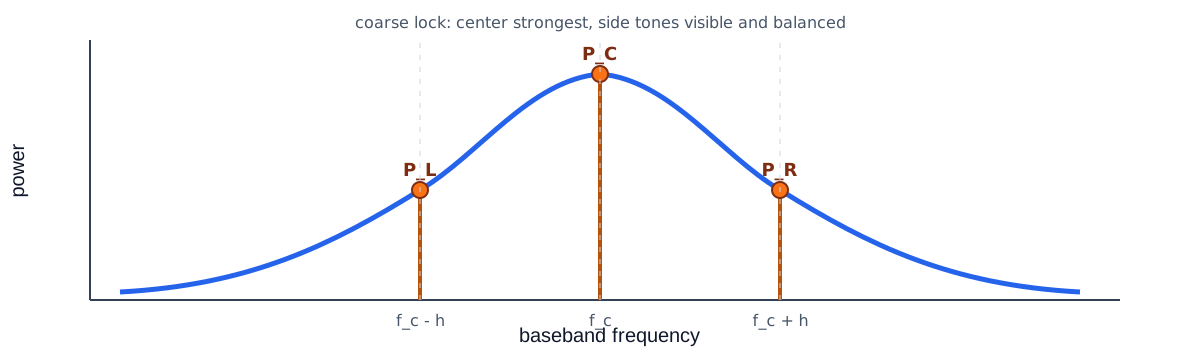
The coarse search is deliberately conservative. A candidate point is accepted only when the center tone is strongest and both side tones are present:
The side tones must also sit inside the acceptance window used by
track3_triplet_match:
track3 coarse sweep
track3 starts from a requested downconversion frequency and walks forward
in fixed Hertz steps:
track3 <channel> <start_hz> [step_hz] [max_steps] [N] [center_hz] [delta_hz]
Typical setup:
fft_fs 10000
track3 1 10002950 10 400 2048 1000 20
For each trial point it:
converts the candidate frequency to a
phase_downincrement,writes the CSR and commits the update,
throws away a short settling window,
captures
Ndownsampled samples from the selected channel,measures
P_L,P_C, andP_R,stops if the three-bin rule passes.
If no lock is found, the firmware restores the original phase increment.
Fine tracking with a three-point parabola
Once the tones are close, trackq treats the three power values as samples of
a peak. With equally spaced samples at f_c-h, f_c, and f_c+h, the
vertex estimate is:
The denominator should be negative for a real peak. If it is not, the firmware does not trust the parabola.
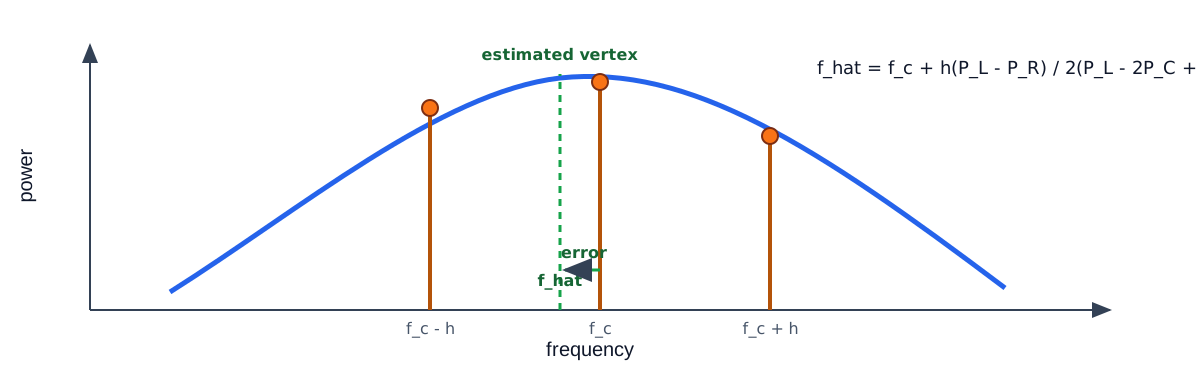
The measured baseband error is:
The controller filters the error:
then applies a small proportional gain:
The fractional part is kept in an accumulator, and the integer-Hertz correction is clamped before it is written back:
Weak measurements
Sometimes the three samples do not pass the full confidence test. The firmware still tries to make a cautious correction if the side powers are clearly unbalanced:
There is a deadband around zero side imbalance, and the weak-mode correction is clamped to only 1 Hz.
Runtime cadence
trackq is serviced from uberclock_poll. The update interval is
TRACKQ_INTERVAL_TICKS, currently 20000 downsample ticks. With the usual
fft_fs 10000 setup, that is a two-second tracking update.
Each update captures the three tracked channels together:
trackq_start <f1> <f2> <f3> [N] [center_hz] [delta_ch1_hz] [delta_ch2_hz] [delta_ch3_hz]
trackq_probe [N] [center_hz] [delta_hz]
trackq_stop
trackq_probe is the useful bench command when tuning. It runs one capture
and prints the three powers and the estimated vertex without waiting for the
periodic background log.
Example application
The following example demonstrates how the tracking algorithm is used to lock onto and continuously follow three resonant oscillator modes. Each mode can drift over time because of temperature changes, aging, or other environmental effects.
The workflow is divided into two stages:
track3performs a coarse search and locates the approximate resonance.trackq_startbegins continuous fine tracking using quadratic interpolation around the detected peak.
3 Tone Tracking
The tracking system positions the CPU-generated tones and CORDIC mixer frequencies near the resonant frequency so that the fine tracker can maintain lock on the moving peak.
C300 Mode
From lab measurements, this tone is expected in the following frequency range:
10.003840 MHz to 10.004000 MHz
The serial console interface is:
track3 <ch> <start_hz> [step_hz] [max_steps] [N] [center_hz] [delta_hz]
First coarse iteration:
uberClock> track3 1 10002840 20 10 2048 1000 20
track3: ch=1 start=10002840 Hz step=20 Hz max_steps=10 N=2048 center=1000 Hz delta=20 Hz Fs=10000 Hz sig3={980,1000,1020} Hz
track3 step=0 phase_down_1=10002840 Hz inc=10327372 bins={201,205,209} pwr={3535,554,323}
track3 step=1 phase_down_1=10002860 Hz inc=10327393 bins={201,205,209} pwr={188,114,66}
track3 step=2 phase_down_1=10002880 Hz inc=10327414 bins={201,205,209} pwr={51,33,42}
track3 step=3 phase_down_1=10002900 Hz inc=10327434 bins={201,205,209} pwr={18,16,25}
track3 step=4 phase_down_1=10002920 Hz inc=10327455 bins={201,205,209} pwr={15,25,25}
track3 step=5 phase_down_1=10002940 Hz inc=10327476 bins={201,205,209} pwr={20,16,13}
track3 step=6 phase_down_1=10002960 Hz inc=10327496 bins={201,205,209} pwr={16,32,17}
track3 lock: phase_down_1=10002960 Hz inc=10327496 center=1000 left=980 right=1020
Second refinement iteration:
uberClock> track3 1 10002940 1 20 2048 1000 10
track3: ch=1 start=10002940 Hz step=1 Hz max_steps=20 N=2048 center=1000 Hz delta=10 Hz Fs=10000 Hz sig3={990,1000,1010} Hz
track3 step=0 phase_down_1=10002940 Hz inc=10327476 bins={203,205,207} pwr={60067,136499,18232}
track3 step=1 phase_down_1=10002941 Hz inc=10327477 bins={203,205,207} pwr={75089,110155,16630}
track3 step=2 phase_down_1=10002942 Hz inc=10327478 bins={203,205,207} pwr={67740,57706,12101}
track3 step=3 phase_down_1=10002943 Hz inc=10327479 bins={203,205,207} pwr={74213,33618,10973}
track3 step=4 phase_down_1=10002944 Hz inc=10327480 bins={203,205,207} pwr={94839,25360,12059}
track3 step=5 phase_down_1=10002945 Hz inc=10327481 bins={203,205,207} pwr={129631,16819,4922}
track3 step=6 phase_down_1=10002946 Hz inc=10327482 bins={203,205,207} pwr={4352,25171,68193}
track3 step=7 phase_down_1=10002947 Hz inc=10327483 bins={203,205,207} pwr={6651,34312,72923}
track3 step=8 phase_down_1=10002948 Hz inc=10327484 bins={203,205,207} pwr={9542,69438,91629}
track3 step=9 phase_down_1=10002949 Hz inc=10327485 bins={203,205,207} pwr={8819,71914,90698}
track3 step=10 phase_down_1=10002950 Hz inc=10327486 bins={203,205,207} pwr={8676,69903,84677}
track3 step=11 phase_down_1=10002951 Hz inc=10327487 bins={203,205,207} pwr={10158,62017,76351}
track3 step=12 phase_down_1=10002952 Hz inc=10327488 bins={203,205,207} pwr={15947,54087,63095}
track3 step=13 phase_down_1=10002953 Hz inc=10327489 bins={203,205,207} pwr={24303,54736,49692}
track3 lock: phase_down_1=10002953 Hz inc=10327489 center=1000 left=990 right=1010
A100 Mode
Expected frequency range:
6.261641 MHz to 6.271641 MHz
Example coarse lock:
uberClock> track3 2 6261000 1000 10 2048 1000 100
track3: ch=2 start=6261000 Hz step=1000 Hz max_steps=10 N=2048 center=1000 Hz delta=100 Hz Fs=10000 Hz sig3={900,1000,1100} Hz
track3 step=0 phase_down_2=6261000 Hz inc=6464132 bins={184,205,225} pwr={0,108,0}
track3 step=1 phase_down_2=6262000 Hz inc=6465164 bins={184,205,225} pwr={0,74,0}
track3 step=2 phase_down_2=6263000 Hz inc=6466197 bins={184,205,225} pwr={0,106,0}
track3 step=3 phase_down_2=6264000 Hz inc=6467229 bins={184,205,225} pwr={0,93,0}
track3 step=4 phase_down_2=6265000 Hz inc=6468262 bins={184,205,225} pwr={0,99,0}
track3 step=5 phase_down_2=6266000 Hz inc=6469294 bins={184,205,225} pwr={0,105,0}
track3 step=6 phase_down_2=6267000 Hz inc=6470326 bins={184,205,225} pwr={0,95,0}
track3 step=7 phase_down_2=6268000 Hz inc=6471359 bins={184,205,225} pwr={77,95,97}
track3 step=8 phase_down_2=6269000 Hz inc=6472391 bins={184,205,225} pwr={96,69,121}
track3 step=9 phase_down_2=6270000 Hz inc=6473424 bins={184,205,225} pwr={105,130,67}
track3 lock: phase_down_2=6270000 Hz inc=6473424 center=1000 left=900 right=1100
C100 Mode
Expected frequency range:
3.388438 MHz to 3.388594 MHz
Example lock:
uberClock> track3 3 3387400 10 10 2048 1000 20
track3: ch=3 start=3387400 Hz step=10 Hz max_steps=10 N=2048 center=1000 Hz delta=20 Hz Fs=10000 Hz sig3={980,1000,1020} Hz
track3 step=0 phase_down_3=3387400 Hz inc=3497301 bins={201,205,209} pwr={14621,15243,11202}
track3 step=1 phase_down_3=3387410 Hz inc=3497311 bins={201,205,209} pwr={13495,13321,9311}
track3 step=2 phase_down_3=3387420 Hz inc=3497321 bins={201,205,209} pwr={14570,10784,7988}
track3 step=3 phase_down_3=3387430 Hz inc=3497331 bins={201,205,209} pwr={12620,9838,7987}
track3 step=4 phase_down_3=3387440 Hz inc=3497342 bins={201,205,209} pwr={10305,8390,8350}
track3 step=5 phase_down_3=3387450 Hz inc=3497352 bins={201,205,209} pwr={10714,9075,7482}
track3 step=6 phase_down_3=3387460 Hz inc=3497362 bins={201,205,209} pwr={8867,9387,6490}
track3 lock: phase_down_3=3387460 Hz inc=3497362 center=1000 left=980 right=1020
Continuous Tracking
Once the initial coarse locks are found, continuous tracking is started with:
trackq_start <f1> <f2> <f3> [N] [center_hz] [delta_ch1_hz] [delta_ch2_hz] [delta_ch3_hz]
Example:
uberClock> trackq_start 10002953 6270000 3387460 2048 1000 10 100 20
trackq_start: ch1=10002953 Hz ch2=6270000 Hz ch3=3387459 Hz N=2048 center=1000 Hz delta={10,100,20} Hz sig3={{990,1000,1010},{900,1000,1100},{980,1000,1020}} Hz interval=2 s
trackq hf vertex: ch1=10003952.591Hz ch2=6270999.743Hz ch3=3388454.227Hz
trackq hf vertex: ch1=10003952.591Hz ch2=6270989.468Hz ch3=3388449.384Hz
trackq hf vertex: ch1=10003952.591Hz ch2=6270977.848Hz ch3=3388445.509Hz
trackq hf vertex: ch1=10003951.622Hz ch2=6270966.016Hz ch3=3388444.541Hz
trackq hf vertex: ch1=10003950.059Hz ch2=6270960.719Hz ch3=3388443.572Hz
trackq hf vertex: ch1=10003949.441Hz ch2=6270955.188Hz ch3=3388442.604Hz
trackq hf vertex: ch1=10003949.540Hz ch2=6270953.199Hz ch3=3388441.635Hz
trackq hf vertex: ch1=10003949.685Hz ch2=6270951.865Hz ch3=3388441.635Hz
trackq hf vertex: ch1=10003949.685Hz ch2=6270945.502Hz ch3=3388437.761Hz
trackq hf vertex: ch1=10003949.685Hz ch2=6270945.502Hz ch3=3388436.792Hz
trackq hf vertex: ch1=10003949.685Hz ch2=6270868.985Hz ch3=3388412.578Hz
Using the low-speed debug signal capture, the three tracking tones can be observed directly in the FPGA debug channels.
The tracker attempts to keep the central 1 kHz tone aligned with the interpolated resonance peak.
All three resonant modes, corresponding to 9 tones in total, can also be observed with the high-speed DDR3 debug capture.
What to watch while testing
The tracker is only as good as the low-rate spectrum it sees. Before trusting
trackq, check these points:
fft_fsmust match the actual downsampled sample rate.Nmust be a power of two and no larger than 2048.The center and side tones must be below Nyquist.
The side spacing should be large enough to measure a slope, but not so large that the side tones stop representing the same resonance peak.
A coarse
track3lock should show a center tone above both side tones, with both side tones still visible.
The code is simple on purpose. It is not a full PLL and it is not trying to model the crystal. It is a measurement loop: look at three nearby points, decide which way the peak moved, and make a small CSR update.